
Nebraska Women in STEM talked to Dr. Katharine Hogan about prairies, imperiled plants, and the power of keeping your options open.
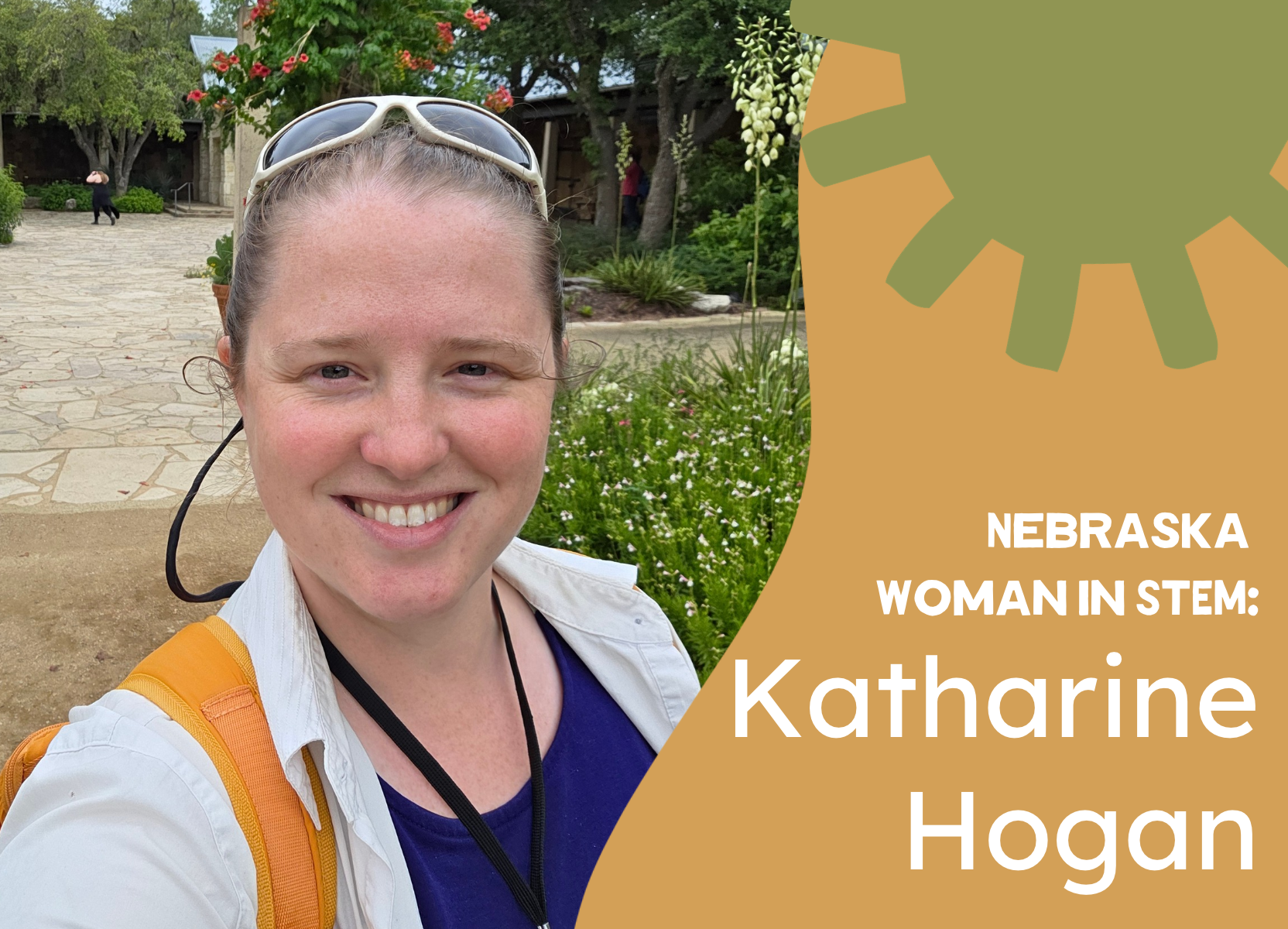
According to Dr. Katharine Hogan, Nebraska is “on the edge of everything.” This state is a transitional landscape, where many organisms, especially plants, live on the far extent of their species ranges. As Director of Conservation at Lauritzen Gardens, Katharine is dedicated to studying and conserving imperiled plants.
“Those peripheral individuals are often the most vulnerable to extinction,” Katharine said.
While there are several hundred species of imperiled plants in Nebraska, and over half of the organisms on the US Threatened and Endangered Species List are plants, plants receive much less attention than animals, including a fraction of the funding.
“All of this information and effort toward individual charismatic animals, but what are we doing for our imperiled plants?” Katharine said.
Her path to that question wasn’t immediate. Growing up in the northeastern United States, her zoologist mother encouraged her to observe nature, and she has always been passionate about the outdoors. It was one great course with a great professor she took in college, natural history of Vermont, that set her on a path in conservation.
“I realized, ‘oh yeah, this is what I want to do,’” Katharine said.
Her professor pointed her to an internship with a wetland restoration nursery, which led to years of seasonal conservation work, including a fellowship with the Nature Conservancy in Nebraska. Katharine said that full-time jobs in conservation are hard to come by, but she accepted the instability of short-term jobs because she enjoyed trying a variety of things.
“I’ve always been reluctant to pigeonhole myself,” Katharine said. “I was always taking the next step that would let me still have that flexibility.”
That direction came from a job posting. She saw a restoration scientist position that required a PhD, and even though she had once sworn she’d never get one, she realized that she wanted to specialize in plant conservation.
“I had been kind of meandering a little bit, and then I got a direction, and I went for it,” she said.
Katharine also found her love for Nebraska prairies, which differed from the mountainous woodlands she grew up in. She stayed in Nebraska, completing her PhD at UNL in prairie restoration.
“Prairies are very dynamic, very resilient, and very surprising,” Katharine said. “I like to vacation and play in the mountains, but I like working in the prairie.”
When she heard Lauritzen Gardens in Omaha was hiring a conservation director, she saw a place where research and applied conservation could meet.
“Botanical gardens sit at this really fun intersection of academic science, research and on-the-ground conservation,” Katharine said.
The conservation department is small but growing, and Katharine is a jack of all trades: from planning conservation research, to surveying plants, to analyzing data. That means being flexible.
“When you’ve got two people on your staff, you kind of have to be a little bit opportunistic,” she said.
Now, her focus is on the plants that are most in peril.
“Working with restoration, I started to get frustrated. Despite all the pros of that approach, like high-diversity prairie restoration, there’s always going to be species that fall through the cracks,” Katharine said.
One example is Lauritzen’s project conserving butternut tree genetics. Only a handful of these trees are known to exist along the Missouri River but could harbor important genetics that could be a key in resilience against butternut canker, a disease that has reduced much of the rest of the population. Katharine’s team spent a week surveying possible habitat and collecting samples from known trees. A recent analysis found no evidence of maternal hybrid ancestry, meaning good news for the possibility of these trees contributing important genetics to future populations.
She doesn’t see her own wandering as a detour. Keeping her options open, she said, lets her see “opportunities that other people don’t,” and it’s what prepared her to bridge research, restoration and the people who do both.