
Nebraska Women in STEM talked to UNL’s Dr. Tala Awada about mentoring in academic leadership.
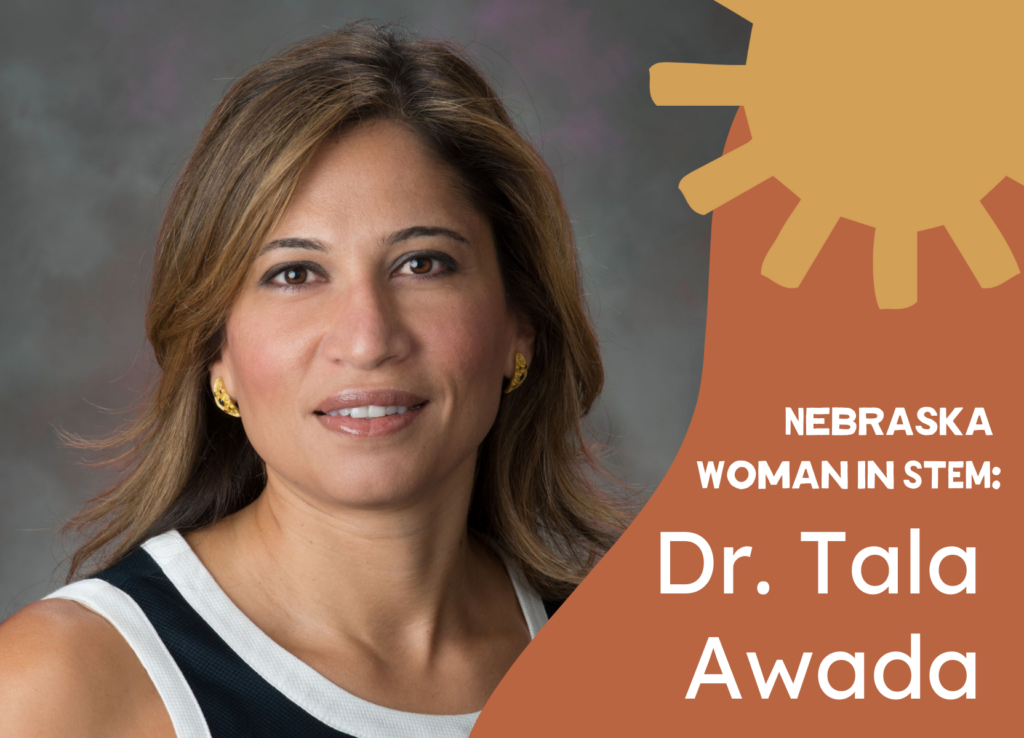
Dr. Tala Awada has been teaching at the University of Nebraska-Lincoln for 26 years and currently serves in the Associate Dean of the Agricultural Research Division in the Institute of Agriculture and Natural Resources. Originally from Tyre, Lebanon, it was at the Lebanese University that she received her Bachelor of Science in Agricultural Engineering, before moving onto Crete, Greece and Saskatchewan, Canada for her master’s and doctoral degrees.
When asked about how she ended up in Nebraska, Awada lit up. “My spouse and I had just graduated from the University of Saskatchewan and had the opportunity to come to Lincoln for an interview. We really liked the university and the community and said that this was the place for us.”
For more than two decades, Awada has brought her leadership and service to UNL’s School of Natural Resources. Much of her day-to-day success relies on her diverse relationships and open mindset. “When you are a part of an inclusive team with individuals that come from different disciplines and have different points of view, you are better equipped to tackle the complex challenges that we have around us in agriculture and natural resources.”
In 2015, she was called on to serve as Associate Dean of the Agricultural Research Division and has been in the position ever since. Awada explains, “I oversee not only the research mission and the mentorship of faculty, but also global engagement. My goal is to build collaborations with our Nebraska, national, and international partners to tackle complex challenges related to agriculture, natural resources, and human health.”
Awada sees her relationships with students as integral to her role as professor. She is proud of the trust she has earned with students and stresses the importance of understanding their individual needs. She says that,“there is not one strategy that applies to everyone. I tailor my mentorship to the personality of the student and what each student needs.”
She also emphasizes respect as a number one priority within her team and classroom. “The first thing that I establish in a lab environment is that different people can have different opinions, and students are free to discuss their opinions, but disagreements must be carried about in a respectful manner. We all work on creating an inclusive, respectful environment.”
Awada’s investment in students and their learning has created space for deep, meaningful mentorships over the years. She says she mentors students from day one through to graduation, including advising them on both their professional and personal journeys. “I make it very clear that I’m here to support them in any way I can. And I keep in touch with all of my students: the good news, the bad news, all of it.”
Her advice to young women in STEM is to stay curious and keep learning. She believes that jobs should be like hobbies and suggests that others find a career that makes them excited to wake up and go to work every morning.
To help women in STEM careers flourish, Awada says that leaders need to provide flexibility, opportunities for growth, and mentorship. As a leader herself, Awada says that her biggest satisfaction comes from helping others realize their potential.
“We need to create more mechanisms to support women through the challenges of their career and give them the opportunity to excel and grow within their positions. When my peers and students succeed, I feel like I have succeeded, and it brings me joy. That’s why I’m in administration.”