
Nebraska Women in STEM talked to Emily Dein about teaching science and breaking stereotypes as a high school cheerleading coach.
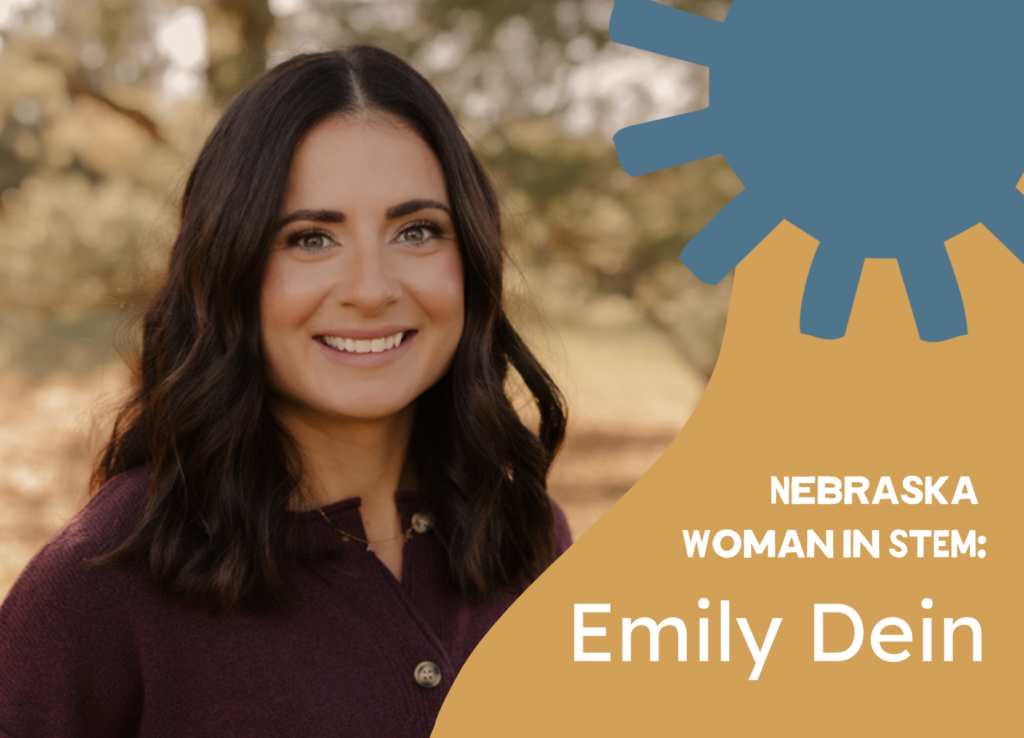
Beatrice High School science teacher Emily Dean has always been drawn to science. “Since I was little, I had an innate interest in it,” she recalls. Early on, she imagined becoming a paleontologist or a marine biologist, but when she discovered she didn’t enjoy swimming, her path shifted. It was high school chemistry and watching forensic science shows like CSI that sparked her true passion. Emily pursued chemistry at Nebraska Wesleyan, initially planning to focus on forensics, but soon realized her calling wasn’t in the lab—it was in the classroom.
Emily has now been a teaching for 12 years, first at Lincoln East and now in Beatrice. Teaching gives her the variety and challenge she was seeking: “Every day is different because of the students. Even though I teach chemistry each year, the experiences and relationships are never the same.”
Her journey hasn’t been without challenges. Emily also works as a cheer and dance coach alongside teaching. As a coach for two female sports, she has encountered an array of stereotypes about what a woman in science should look like. Some colleagues questioned how she could embody both roles. But Emily never saw a contradiction. “You can’t judge a book by its cover,” she says. “There are layers to people. You’re not just a student, a cheerleader, or a science lover—you can be all of those things.”
Emily is a huge advocate for her students and her athletes. She believes that all young people have the capability to be leaders. “People put a stigma on what true leaders should act like. People don’t always fall into clear categories.”
This belief in breaking boxes has deeply shaped her teaching. Emily focuses on helping students see themselves as more than labels, creating a classroom where mistakes are part of the learning process. She allows students to redo assignments and tests, giving them opportunities to truly master material. “I want them to learn from their mistakes,” she says. “The skills they gain in chemistry—like problem solving and persistence—can be applied far beyond science.”
Her mentorship has left lasting impressions. One of her students, once unsure about chemistry, later pursued a PhD in biochemistry research. “She told me that I steered her in the chemistry direction,” Emily reflects. “That’s the most rewarding part—helping students see potential in themselves they didn’t know was there.”
Another student and cheerleader said that Coach Emily was a huge role model for her. “I always felt out of place in high school. I was too nerdy for the girls on my cheer team, but too preppy for the smart kids in my classes. Coach Emily showed me that I could be true to myself.”
Emily has also pushed herself to grow, earning her master’s degree while balancing teaching, coaching, and motherhood. It required sacrifices—weekends spent on coursework instead of leisure—but she believes that graduate school has her a stronger teacher. “It gave me a deeper understanding of chemistry and also reminded me what it feels like to be a student again. That perspective makes me more empathetic with my own students.”
For Emily, STEM is more than equations and experiments; it’s about building resilience, challenging stereotypes, and helping young people discover who they can be. Her own journey, combining science, cheerleading, teaching, and family life, is a testament to the idea that movement in STEM can take many forms. By embracing her passions fully, she has created space for her students—especially young women—to do the same.