
Nebraska Women in STEM talked to Haiwei Lu about plants, medicine and the power of curiosity.
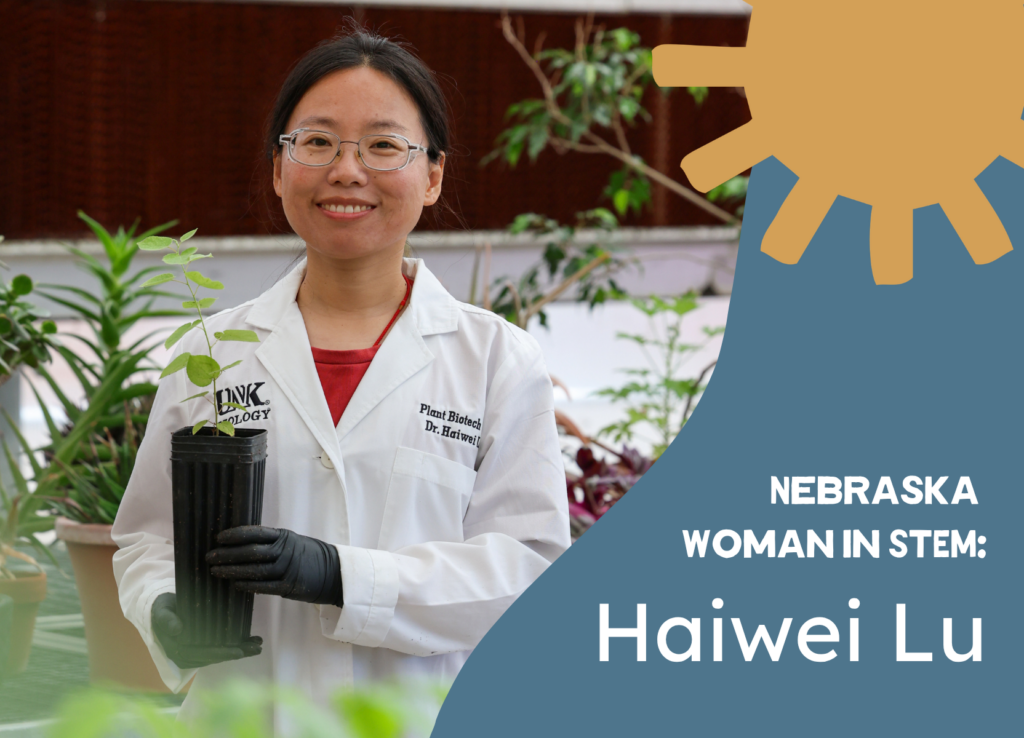
When University of Nebraska-Kearney assistant professor Dr. Haiwei Lu first learned about green fluorescent protein, or GFP, the possibilities of genetic modification in plants seemed endless. GFP, which occurs naturally in jellyfish, can be used by researchers as a marker to help them see what is happening inside genetically modified organisms.
“When I heard about the GFP gene, probably when I was in undergraduate, my instructor was talking about how now scientists can produce tobacco plants that glow in the dark,” Haiwei said. “I thought ‘that’s cool, I want a glowing plant!’”
She later learned that using GFP doesn’t quite result in the glowing plant she originally pictured (observing the glow requires UV light and special camera filters), but that interest led Haiwei toward plant biotechnology. During her PhD she investigated ways to use genetic editing to disrupt flowering in poplar trees as a test to combat concerns with genetically modified organisms.
“With genetically modified organisms, or transgenic plants, people are always concerned about whether the genes will flow into the environment, called gene flow,” Haiwei said. “We wanted to make the trees sterile so they don’t produce viable seeds.”
Haiwei found her passion in research and pictured herself working with a research group indefinitely. But during her postdoctoral position at Oak Ridge National Laboratory in Tennessee, she found herself, her husband, and their young son living in different states. With travel limited during the COVID-19 shutdown, the family’s need to be together again eventually brought Haiwei to Nebraska.
She received a job offer to teach anatomy and physiology at Central Community College in Hastings, and this plant scientist faced a new challenge: human biology.
“I still remember my first semester — it’s a dark age for me,” Haiwei said. “It’s totally out of my expertise. I basically taught everything to myself before I delivered the content to my students.”
But, crediting her Phd training which gave her the “ability to learn almost anything,” she realized there were many more parallels between plants and humans than she imagined.
Humans and plants are very different, but for a lot of the fundamental rules of physiological processes, they share a common foundation,” Haiwei said. “For example, in plants we have metabolic pathways, and the same for humans… It also made me pause and think ‘we know plants, and we seem to know ourselves a lot better, but in reality we don’t know exactly how things are controlled, even in ourselves.’”
Today, Haiwei continues to teach anatomy and physiology at UNK as well as conduct research on plant pathways. Her research remains centered on poplar trees, which have largely unexplored medicinal applications.
Poplars produce a class of specialized compounds called salicinoids, including salicin, a compound that helped lead to the development of aspirin. Research also suggests that some salicinoids may have potential applications in areas ranging from inflammation to cancer. Better understanding plant-based compounds to improve lives is one of the many wonders of plants.
“About a quarter of the prescription medicines that we use have ingredients directly derived from plants, and over 60% of anticancer drugs originate from plants,” Haiwei said. “While compounds with simple structures can be synthesized chemically, many plant metabolites, including salicinoids, are structurally complicated.”
Rather than trying to recreate complex salicinoid compounds in a laboratory, Haiwei is investigating whether researchers can use the plant’s own natural processes to produce higher levels of this compound..
It is a fitting direction for a scientist whose career began with the simple wonder of a plant that could glow.
“I’m excited that I have the chance to work at UNK, study plants, and have the chance to help students realize… plants have very important roles as medicinal compounds,” Haiwei said. “I look forward to opportunities to engage more students in plant science and help them realize all the different roles that plants play in our lives.”
For Haiwei, that may be the most important lesson plants have to offer: there is still so much we don’t know, and some of the most interesting discoveries begin with simply being curious.